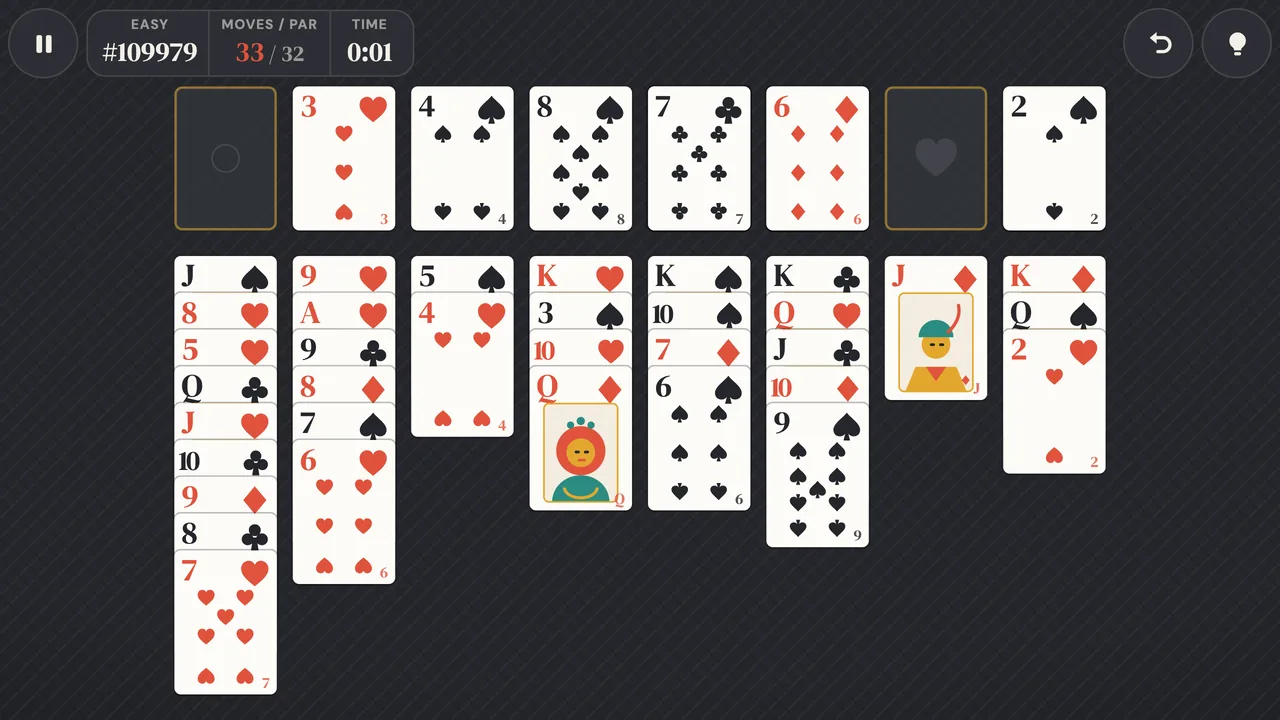
FreeCell has a famous number: 11982. It is the only deal among the original 32,000 Microsoft FreeCell deals that cannot be won, no matter how well you play. Every other deal in that set has a solution, which is why FreeCell earned its reputation as the solitaire you can almost always beat. Here is the story of 11982, the other impossible deals, and what makes a deal hard. New to the game? Start with the FreeCell rules.
Where deal numbers come from
When FreeCell shipped with Windows in the 1990s, each deal was generated from a number, 1 to 32,000. The same number always produced the same shuffle, so players could talk about "deal 617" and know they were looking at the same cards. Later versions extended the range to a million deals using the same shuffle method. FreeCell Doodle shuffles deals 1 to 1,000,000 the same way, so you can type in a number you remember and replay it.
How 11982 was found
In the mid-1990s, an internet project set out to solve all 32,000 deals. Volunteers each took a block of deals and solved them by hand, sharing the results online, and computer solvers were used to double-check the toughest cases. Every deal fell except one: 11982. Exhaustive computer searches later confirmed that no sequence of legal moves wins it. It isn't merely hard; it is impossible.
The other impossible deals
Among the first million deals, solver programs have found only a handful with no solution: 11982, 146692, 186216, 455889, 495505, 512118, 517776 and 781948. That is eight in a million. Some old versions of Windows FreeCell also had hidden deals numbered −1 and −2 that were impossible by design, a little joke for curious players.
FreeCell Doodle never serves the deals known to have no solution, and solves every deal before you see it, so each one has a winning line.
What makes a deal impossible?
FreeCell is unwinnable when the cards you need are trapped in a way no amount of space can fix. Typical ingredients:
- Low cards buried deep, especially Aces and 2s at the bottom of long columns.
- Several high cards blocking each other, where each needs a place the others occupy.
- Same-colour runs, which can't be built on each other (a red 7 can't go on a red 8), so cards stack up with nowhere to go.
With four free cells and eight columns you can usually unpick these knots. In 11982, the knot is too tight.
What makes a deal hard (but winnable)?
Most "hard" deals need a long, precise plan rather than luck. They often share the same features in a milder form: buried Aces, few natural runs, and Kings sitting on top of low cards. FreeCell Doodle measures each deal's par, the length of its solver's solution with redundant moves removed, and sorts deals into Easy, Medium and Hard by par. Longer par usually means a harder deal.
Want a tougher FreeCell?
If ordinary deals feel easy, change the rules instead of hunting for impossible ones. Playing with fewer free cells makes every deal far harder. In FreeCell Doodle, three Hard wins open Tight (one free cell locked) and three Tight wins open Brutal (only two free cells). Many deals that are routine with four cells become real puzzles with two.
Tips for hard deals
When a deal fights back, the habits that win it are in our FreeCell strategy guide. The one that matters most here: when stuck, undo several moves rather than one, because the mistake is usually earlier than you think.
Quick facts
| Original Microsoft deals | 32,000 |
| Impossible among them | 1 (deal 11982) |
| Impossible in the first million | 8 |
| Served by FreeCell Doodle | Only deals its solver has won |